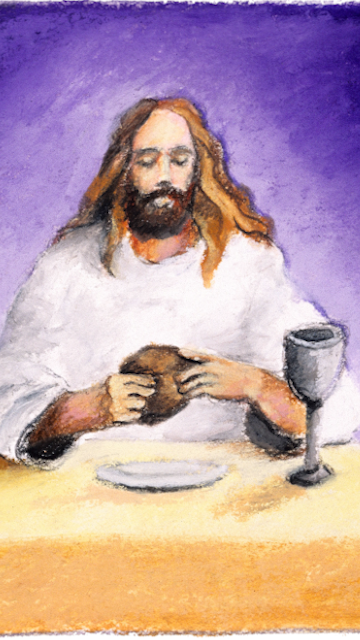
Do this to remember me.
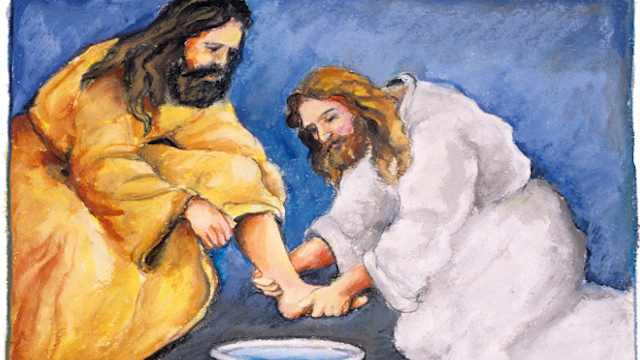
... the leader should be like the servant.
Home / Kids' Cove / Last Supper
Home / Kids' Cove / Last Supper
Matthew tells us about Jesus preparing for the Passover meal on the fourth day Jesus and his followers were in Jerusalem:
On the first day of the Feast of Unleavened Bread, the followers came to Jesus. They said, “We will prepare everything for you to eat the Passover Feast. Where do you want to have the feast?”
Jesus answered, “Go into the city to a certain man. Tell him that the Teacher says, ‘The chosen time is near. I will have the Passover Feast with my followers at your house.’” The followers did what Jesus told them to do, and they prepared the Passover Feast.
[Matthew 26:17-19, ICB]
Luke tells us about a command that Jesus gave his apostles and us during the Passover meal:
When the time came, Jesus and the apostles were sitting at the table. He said to them, “I wanted very much to eat this Passover meal with you before I die. I will never eat another Passover meal until it is given its true meaning in the kingdom of God.”
Then Jesus took a cup. He gave thanks to God for it and said, “Take this cup and give it to everyone here. I will not drink again from the fruit of the vine until God’s kingdom comes.”
Then Jesus took some bread. He thanked God for it, broke it, and gave it to the apostles. Then Jesus said, “This bread is my body that I am giving for you. Do this to remember me.” In the same way, after supper, Jesus took the cup and said, “This cup shows the new agreement that God makes with his people. This new agreement begins with my blood which is poured out for you.”
[Luke 22:14-20, ICB]
John tells us about Jesus washing his followers feet during the Passover meal:
So during the meal Jesus stood up and took off his outer clothing. Taking a towel, he wrapped it around his waist. Then he poured water into a bowl and began to wash the followers’ feet. He dried them with the towel that was wrapped around him.
[John 13:4-5, ICB]
John continues his story by saying:
When he had finished washing their feet, he put on his clothes and sat down again. Jesus asked, “Do you understand what I have just done for you? You call me ‘Teacher’ and ‘Lord.’ And this is right, because that is what I am. I, your Lord and Teacher, have washed your feet. So you also should wash each other’s feet. I did this as an example for you. So you should do as I have done for you. I tell you the truth. A servant is not greater than his master. A messenger is not greater than the one who sent him. If you know these things, you will be happy if you do them.
[John 13:12-17, ICB]
Luke also tells us about Jesus ordering his followers and us
to be like servants
during the Passover meal:
Then the apostles began to argue about which one of them was the most important. But Jesus said to them, “The kings of the world rule over their people. Men who have authority over others are called ‘very important.’ But you must not be like that. The greatest among you should be like the youngest, and the leader should be like the servant. Who is more important: the one sitting at the table or the one serving him? You think the one at the table is more important. But I am like a servant among you!
[Luke 22:24-27, ICB]
I come with joy to meet my Lord,
forgiven, loved, and free;
in awe and wonder to recall
his life laid down for me.
I come with Christians far and near
to find, as all are fed,
the new community of love
in Christ's communion bread.
As Christ breaks bread and bids us share,
each proud division ends;
the love that made us, makes us one,
and strangers now are friends.
And thus with joy we meet our Lord;
his presence, always near,
is in such friendship better known:
we see and praise him here.
Together met, together bound,
we'll go our different ways;
and as his people in the world,
we'll live and speak his praise
[Hymn #304, 1982 Hymnal]
Let us break bread together on our knees, (on our knees)
Let us break bread together on our knees. (on our knees)
When I fall on my knees with my face to the rising sun,
O Lord, have mercy on me.
Let us drink wine together on our knees, (on our knees)
Let us drink wine together on our knees. (on our knees)
When I fall on my knees with my face to the rising sun,
O Lord, have mercy on me.
Let us praise God together on our knees, (on our knees)
Let us praise God together on our knees. (on our knees)
When I fall on my knees with my face to the rising sun,
O Lord, have mercy on me.
[Spiritual]
Recall the Sadducee trying to trick Jesus by asking which was the most important law. Jesus answered:
Jesus answered, “‘Love the Lord your God with all your heart, soul and mind.’ This is the first and most important command. And the second command is like the first: ‘Love your neighbor as you love yourself.’ All the law and the writings of the prophets depend on these two commands.” [Matthew 22:37-40, ICB]
Think about the commands to "Do this to remember me" and "the leader should be like the servant." Then think about the commands to love God and love your neighbor. Do you see how the commands are alike? Is remembering Jesus sharing bread and wine with his followers a way to remind us to love God? Is being like a servant a way to put your love of your neighbor into action?
Make a kind of bread that might have been shared in Jesus' time, especially among poor families. Use the following recipe (from Living Bread, by Christine Whitehorn Stugard; Forward Movement, 1983; p. 15):
3/4 cup whole-wheat flour
1/2 cup white flour
3/8 teaspoon baking soda
1 heaping tablespoon of shortening
3/8 teaspoon salt
3/8 cup cold water
1 1/2 tablespoons honeyMix well the flours, soda, and salt (sifted well before measuring). Add shortening. Blend very well. Add water and honey. Knead for a good texture. Spread the dough into a pan, or roll it flat with a rolling pin and place it in a pan. The dough may be cut into wafers. Bake 10 to 12 minutes at 350 degrees. A toaster oven may be used, if that is more convenient. (Makes enough for 15 people.)
Yes, the story of the Last Supper includes betrayal and bickering;
however, those are the emphasis of "Betrayals of Jesus." During the
Last Supper, Jesus is telling us of his impending death and how we should
trust in God (Love thee God). Jesus is also trying to prepare his apostles
and us for our role as leaders in our lives. To be leaders we must live
the second commandment, love our neighbors as ourselves.
The Last
Supper gives us Jesus's living example of loving God and loving our neighbor.
The command, Do this to remember me,
leads to the Eucharist at which
we observe the commandment and reaffirm our love for God. The commandment to
to be like a servant
reminds us to give action to
loving our neighbors as ourselves.
The Thursday in Holy Week. It is part of the Triduum, or three holy days
before Easter. It comes from the Latin mandatum novum, "new commandment,"
from Jn 13:34. [source] The three holy days are Maundy Thursday, Good
Friday, and Easter. Mandatum
is the Latin word from which
"mandate" and "maundy" are derived. For more information
about Maundy Thursday, see The Episcopal Church description and the Book of Common Prayer,
p.274.
Images and activities are from Virginia Theological Seminary, Episcopal Children's Curriculum. The music is from Small Church Music. The Bible verses are from the International Children's Bible on Bible Gateway. The narrative words and Discussion are mine (Jo-Mae Maris). We at St. Peter's hope you find this an enlightening experience to share with your child.